Humidifier White Dust in Colorado Winters: What It Is
White powder on furniture after running a humidifier? It's usually minerals from tap water. What causes it, how to reduce it and what it means for your ducts.
Colorado winters are dry, and many Arvada households run a humidifier for comfort once the heat comes on. Then a strange thing happens: a fine white film shows up on the TV, the dresser and the dark furniture near the humidifier. It wipes away easily, but it comes back.
If that sounds familiar, the humidifier is the likely cause, not your ducts. Here's what's going on and what to do about it.
What "white dust" is
According to the EPA, ultrasonic and impeller (cool mist) humidifiers are very efficient at dispersing the minerals in tap water into the air. When the water droplets evaporate, the minerals are left behind and settle on surfaces as a fine white powder. The EPA calls this "white dust."
The amount you see depends mostly on two things:
- The type of humidifier. Ultrasonic and impeller models are the ones the EPA identifies with white dust. The EPA says evaporative models, which blow air through a moistened wick or filter, and steam vaporizers generally disperse less, if any, of those minerals into the air.
- Your water. The more minerals in your tap water, the more residue you're likely to see.
White dust tends to be heaviest near the humidifier and on dark, smooth surfaces where it's easy to see.
How to reduce it
The EPA's guidance on home humidifiers offers a few practical steps:
- Use water with lower mineral content. The EPA recommends low-mineral water, such as bottled water labeled "distilled." Water labeled "spring" or "mineral" hasn't been treated to remove minerals.
- Consider demineralization cartridges or filters if your humidifier accepts them, but watch the results. The EPA notes that their effectiveness varies, and white dust is a sign that minerals aren't being removed.
- Clean the humidifier as the manufacturer directs. The EPA suggests cleaning portable units every third day to reduce scale buildup.
- Empty and refill the tank daily, as the EPA recommends, rather than topping off water that's been sitting.
- Don't over-humidify. The EPA advises against humidifying above 50 percent relative humidity. An inexpensive hygrometer from a hardware store shows you where you are.
Moving a portable unit away from electronics and dark furniture also helps, though it doesn't reduce the total amount of mineral in the air.
Does white dust get into the ducts?
Some of it can. Your HVAC system's return grilles pull room air back toward the furnace, and fine particles floating in that air go with it. Your furnace filter catches some of them. If you run a portable ultrasonic humidifier near a return grille, you may notice white residue on the grille itself.
In most homes, this isn't a reason to clean the ducts. Start with the steps above and a fresh filter. The EPA recommends the highest-efficiency filter your HVAC system's manufacturer allows, changed regularly.
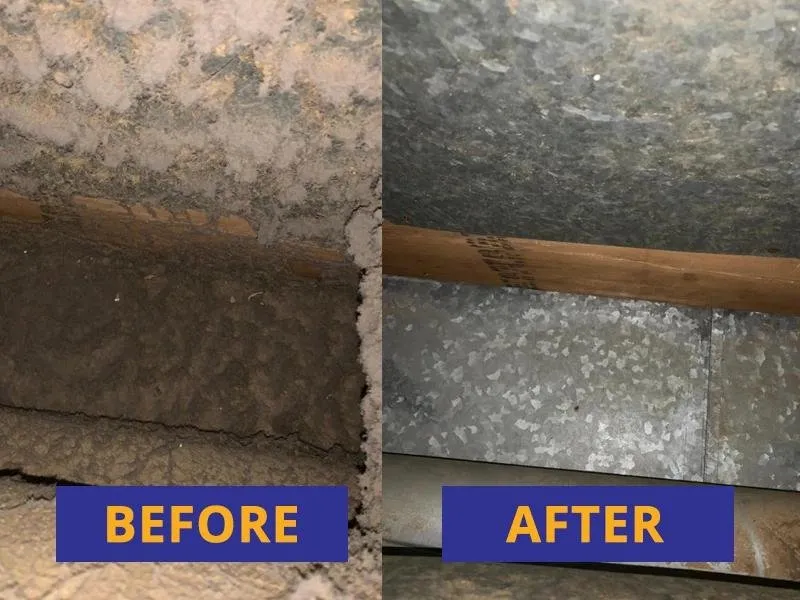
A cleaning is worth considering if you see dust actually blowing out of supply registers, or if you lift a register cover and find heavy buildup inside. Those are among the situations the EPA describes as reasons to consider duct cleaning. Our air duct cleaning covers the supply and return ducts and the registers, at $199 for up to 10 vents plus $29 for each additional vent.
Whole-house humidifiers are different
Some Colorado homes have a whole-house humidifier mounted on the furnace or the ductwork. These usually work differently from portable ultrasonic units, and they're part of your HVAC equipment.
The EPA's duct guidance says that if your system has an in-duct humidifier, you should follow the manufacturer's instructions for operating and maintaining it. That usually includes replacing the water panel or pad and checking the drain on a schedule. It also recommends watching for moisture, since water in ducts is something to avoid.
Whole-house humidifier service is HVAC contractor work, not part of a duct cleaning. If you notice water stains around the humidifier, dripping from the ductwork or musty smells near it, have an HVAC contractor check it. If you suspect mold, a qualified professional should assess it.
A quick winter routine
- Use distilled water in portable ultrasonic or impeller humidifiers.
- Clean the humidifier on the manufacturer's schedule.
- Keep indoor humidity at or below 50 percent.
- Change the furnace filter regularly.
- Have a whole-house humidifier serviced by an HVAC contractor.
We also serve communities around Arvada; see our service areas.
If you've done all that and registers still blow dust, request a free estimate from Pure Green Air Duct Cleaning Arvada.
Sources
- Should You Have the Air Ducts in Your Home Cleaned?, U.S. EPA, last updated February 19, 2026
- Use and Care of Home Humidifiers, U.S. EPA, last updated April 29, 2026
- Evaporative Cooling Systems, Building America Solution Center (PNNL, U.S. DOE), last updated December 29, 2022